
Rita Hayworth and Humphrey Bogart became two defining stars of Hollywood’s Golden Age. Yet they never formed the famous screen partnership their careers seemed destined to produce. Their connection instead involves proposed castings, missed opportunities, and two enduring film-noir classics.
Direct answer: Rita Hayworth and Humphrey Bogart never became a major on-screen couple, despite several opportunities for them to work together. Bogart was considered for Gilda, while Hayworth was originally intended for Dead Reckoning. Casting changes kept them apart, leaving one of classic Hollywood’s most intriguing unrealized star pairings.
Rita Hayworth and Humphrey Bogart at a Glance
| Category | Rita Hayworth | Humphrey Bogart |
|---|---|---|
| Full name | Margarita Carmen Cansino | Humphrey DeForest Bogart |
| Born | October 17, 1918 | December 25, 1899 |
| Birthplace | New York City | New York City |
| Best-known films | Gilda, Cover Girl, The Lady from Shanghai | Casablanca, The Maltese Falcon, The African Queen |
| Signature screen image | Glamorous dancer and dramatic star | Tough, restrained leading man |
| Major 1940s noir connection | Gilda | The Maltese Falcon, The Big Sleep |
| Famous screen partner | Glenn Ford | Lauren Bacall |
| Died | May 14, 1987 | January 14, 1957 |
Did Rita Hayworth and Humphrey Bogart Ever Make a Movie Together?
The simple answer is no. Their filmographies crossed through proposed projects rather than a famous completed collaboration. That distinction explains why searches for the pair can produce confusing stories about casting.
Hollywood studios did consider putting the two stars together. The American Film Institute records a 1942 announcement naming them for a Columbia production eventually released as Once Upon a Time. Production changes followed, and Bogart was replaced before the completed movie reached audiences.
Another opportunity emerged later at Columbia. The studio planned Dead Reckoning as a potential vehicle for Hayworth following her enormous success in Gilda. Bogart remained with the project, but Hayworth did not.
Those near-misses created a fascinating Hollywood question. Their careers occupied similar territory, yet audiences never received the obvious Hayworth-Bogart pairing.
Why Humphrey Bogart Was Connected to Gilda
The most famous connection begins with Gilda, released by Columbia Pictures in 1946. The movie became inseparable from Hayworth’s screen image and established one of her signature performances. Glenn Ford ultimately played Johnny Farrell opposite her.
Bogart was reportedly approached during the movie’s development. Accounts of the production say he declined the male lead, which eventually went to Ford. The decision helped create one of the defining Hayworth-Ford collaborations.
The casting possibility makes sense when viewed beside Casablanca. Both movies feature Americans abroad, complicated romances, nightlife settings, and dangerous political undercurrents. Film historians and critics have repeatedly noted those structural similarities.
Yet Gilda developed a personality separate from Casablanca. Its emotional center rests heavily on attraction, resentment, jealousy, and sexual tension. Hayworth’s commanding presence also makes Gilda herself the character audiences remember first.
Gilda and Casablanca: Why the Connection Matters
Comparing these films helps explain why the proposed casting remains interesting. Casablanca had already made Bogart a defining romantic leading man by the time Gilda appeared. His Rick Blaine combined emotional restraint with the cynical exterior associated with his screen persona.
Gilda also needed a male character carrying bitterness beneath a controlled surface. Johnny Farrell enters the story as a gambler before becoming involved with casino owner Ballin Mundson. His past relationship with Gilda soon turns that arrangement into a volatile triangle.
The similarities stop short of making the films interchangeable. Casablanca places sacrifice and wartime duty beside its central romance. Gilda creates a darker relationship built around mistrust, desire, punishment, and reconciliation.
That difference makes Bogart’s unrealized casting especially intriguing. His established persona could have shifted Johnny toward the weary toughness familiar from his other films. Ford instead created a tense chemistry with Hayworth that became essential to the finished picture.
Dead Reckoning Nearly Brought Them Together
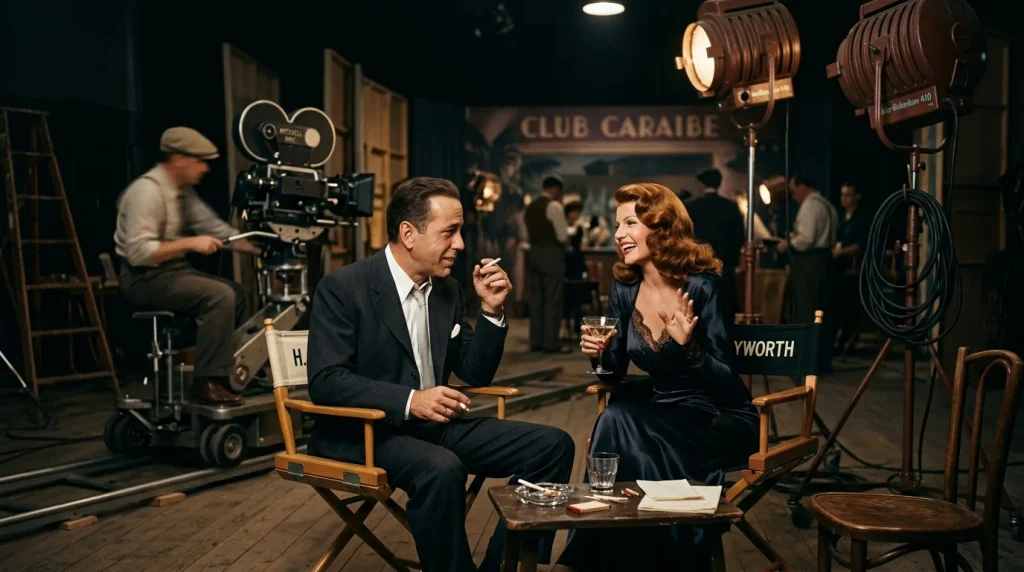
The story also works in reverse. After Gilda, Columbia wanted another successful vehicle associated with Hayworth. Dead Reckoning, released in 1947, became another chance for the studio to connect her with Bogart.
Hayworth was initially intended for the project, but she was involved in a dispute with Columbia. Lizabeth Scott eventually took the female lead opposite Bogart. The completed film therefore became another near-collaboration rather than their shared movie.
This missed opportunity matters because the pairing would have been commercially logical. Hayworth was one of Columbia’s biggest attractions, while Bogart had become one of American cinema’s most recognizable stars. Both could carry stories mixing romance, danger, distrust, and morally complicated characters.
Their absence from the same finished feature feels unusual in hindsight. Hollywood often built films around star combinations with proven audience appeal. In this case, circumstances repeatedly kept two compatible screen personas apart.
Their Different Paths Through 1940s Hollywood
Hayworth entered the decade with a background that included dancing and supporting film roles. Her performances with Fred Astaire helped display her musical abilities before Gilda reshaped her public image. The film transformed her into one of the era’s most recognizable stars.
That glamorous image could also become restrictive. Audiences often associated the actress with Gilda’s confidence and sensuality rather than Hayworth’s broader abilities. Her later work included The Lady from Shanghai, directed by her then-husband Orson Welles.
Bogart reached stardom through a different route. Years of supporting roles and gangster characters preceded his emergence as a major leading man. The Maltese Falcon and Casablanca helped establish the screen identity that followed him throughout his career.
His partnership with Lauren Bacall became another defining part of that identity. They appeared together in films including To Have and Have Not and The Big Sleep. Their personal relationship also made them one of Hollywood’s most famous couples.
Hayworth, Bogart, and the Power of Screen Personas
The near-pairing is interesting because both actors represented recognizable but different forms of 1940s stardom. Hayworth projected glamour, movement, vulnerability, and carefully constructed movie-star confidence. Bogart projected skepticism, intelligence, toughness, and emotional restraint.
Putting those qualities together could have produced sharp dramatic tension. A Hayworth character might challenge the emotional defenses associated with Bogart’s screen persona. His controlled style could have created a striking contrast with her physical and expressive performance.
That possibility remains speculation because no finished feature allows a direct comparison. What survives instead is evidence of how studios imagined both stars. Their names could be attached to the same projects because each carried considerable audience recognition.
For more profiles of actors and popular culture, readers can browse Tablogy’s Entertainment section. The site also covers performers from later Hollywood eras, including Colin Farrell and Walter Jones. These profiles show how screen careers can develop through dramatically different periods and genres.
Why People Still Connect Rita Hayworth and Humphrey Bogart
Classic films rarely exist in isolation. Casting histories reveal alternate versions of familiar movies that audiences never saw. A single decision can change an actor’s career and the identity of a film.
The Hayworth-Bogart story offers two particularly clear examples. Bogart could have occupied the male side of Gilda, while Hayworth could have appeared opposite him in Dead Reckoning. Neither possibility became the movie audiences know today.
Those decisions also protected two famous partnerships from comparison with an unrealized one. Hayworth and Ford became strongly associated through their films together. Bogart and Bacall developed an even more celebrated screen and personal partnership.
The result is a Hollywood connection built largely around what might have happened. That makes it more interesting than a simple list of shared credits. Their story reveals how close major stars could come to working together without producing the expected collaboration.
Rita Hayworth and Humphrey Bogart: What Their Near-Pairing Tells Us
Rita Hayworth and Humphrey Bogart belonged to the same extraordinary period of American filmmaking. Both became symbols of 1940s Hollywood, especially through films involving romance, danger, and complicated loyalties. Their paths repeatedly approached each other without settling into a completed star vehicle.
That history also shows how casting can reshape cinema. Glenn Ford’s presence became fundamental to Gilda, while Lizabeth Scott became Bogart’s co-star in Dead Reckoning. Those choices created the films that audiences inherited.
For modern viewers, the unrealized pairing adds another layer to both careers. Watching Gilda after knowing Bogart was considered can change how Johnny Farrell appears. Watching Dead Reckoning can likewise invite viewers to imagine how Hayworth might have changed its central relationship.
The best next step is to watch Gilda and Casablanca close together. Their shared ingredients become easy to spot, while their different emotional tones become even clearer. Then Dead Reckoning completes the story of the collaboration Hollywood repeatedly approached but never delivered.
Frequently Asked Questions
Did Rita Hayworth and Humphrey Bogart ever star together?
No famous completed feature paired Rita Hayworth and Humphrey Bogart as co-stars. Their names became connected through projects where studios considered or planned them for related roles. Casting and production changes ultimately prevented the expected collaboration.
Was Humphrey Bogart supposed to be in Gilda?
Bogart was reportedly considered for Johnny Farrell, the male lead in Gilda. He did not take the role, and Glenn Ford ultimately played Johnny opposite Hayworth. Ford’s performance became closely associated with the movie’s lasting identity.
Was Rita Hayworth supposed to appear in Dead Reckoning?
Columbia initially envisioned Hayworth for the female role in Dead Reckoning. She did not make the film during her contract difficulties with the studio. Lizabeth Scott ultimately starred opposite Bogart in the 1947 release.
Who starred opposite Rita Hayworth in Gilda?
Glenn Ford played Johnny Farrell opposite Hayworth’s Gilda. George Macready played Ballin Mundson, creating the movie’s central relationship triangle. The film became one of the defining works in both Hayworth’s and Ford’s careers.
Why are Gilda and Casablanca often compared?
Both movies involve American protagonists abroad, nightlife settings, romantic history, and political danger. Their emotional approaches differ despite those similarities. Casablanca emphasizes sacrifice, while Gilda focuses more intensely on desire, jealousy, and mistrust.
Who were their most famous screen partners?
Hayworth is strongly associated with Glenn Ford, especially through Gilda. Bogart’s most famous recurring partner was Lauren Bacall, his co-star and wife. Their respective partnerships helped shape how later audiences remember both stars.